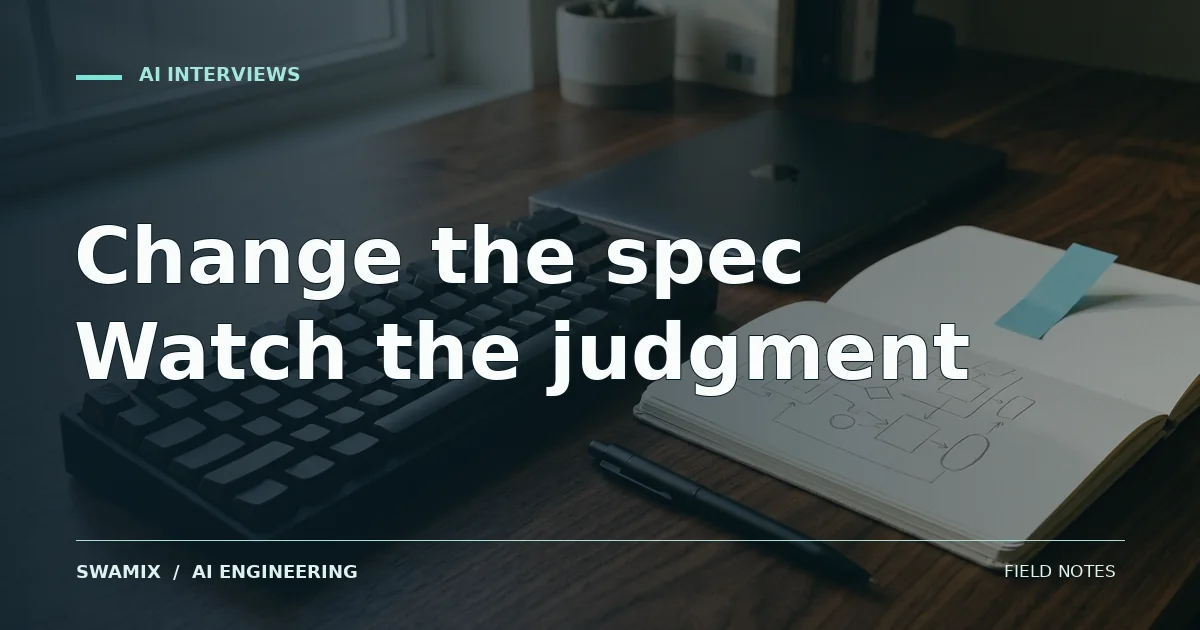
A coding interview that permits AI should not be a contest in who can coax the prettiest first patch from a model. The more revealing moment is what happens next: can the candidate explain the change, find what it missed, and adapt when a real requirement shifts? That gives interviewers a practical way to see engineering judgment without turning the session into AI-detection theater.
A patch is only the opening move
Reporting: A November 2026 Ask HN thread captures conflicting interview rules: some employers treat AI use as a red flag, while others allow it for boilerplate or autocomplete. One commenter argues candidates should be explicitly told they may ask clarifying questions. It is a discussion, not a representative survey, but it illustrates how much the rules can vary S1.
HackerRank’s July 2026 product post describes Plan-Build-Review assessments in prebuilt repositories, where candidates investigate an issue, plan an AI-assisted fix, implement it, and explain the result S2. Canva’s June 2025 engineering post, clearly an earlier example rather than a new launch, says candidates are told ahead of time that AI use is expected S3. These are descriptions of assessment formats, not controlled evidence that one format predicts job performance better than another.
Change one constraint, not the rules
Give the candidate a modest, role-relevant issue in a starter codebase and state the tool policy before the clock starts. Tell them there will be a second requirement after the first pass, but keep that addition the same for every candidate. For example, a request that initially works may need to tolerate retries. That is a realistic change in scope, not a surprise test of whether someone can guess the interviewer’s hidden rubric.
When the new constraint arrives, ask the candidate to identify which assumptions and tests need to change before editing. Then watch how they revise the smallest useful slice, check AI-generated suggestions, and explain what remains unfinished. Score the impact analysis, test choice, code ownership, and trade-offs—not prompt theatrics, typing speed, or feature count. Keep the repository, time, permitted tools, and follow-up consistent across candidates.
Make the work trial reciprocal
A Y Combinator profile of engineer Vin Bui describes a work trial in which he saw what the company’s codebase needed and assessed whether he could make a meaningful contribution S4. That is one person’s account, not evidence about hiring outcomes generally, but it is a useful reminder: candidates are evaluating the job as well as being evaluated.
A good interview therefore makes the constraints and AI policy legible, gives candidates room to ask questions, and leaves time to discuss the work. The interviewer learns whether the candidate can reason through change; the candidate learns whether the team’s engineering problems are ones they want to solve. A polished first patch can be generated. A clear explanation of what must change—and why—is a more useful conversation.
Sources and editorial method
This AI-assisted report synthesizes the sources below. Automated source checking is not independent human verification; follow the original reporting for context and updates.
Common questions
What should an AI-assisted coding interview measure?
Measure how a candidate understands requirements, checks generated code, tests key assumptions and adapts to a change—not prompt style alone.
How can teams keep the assessment fair?
Tell candidates which tools are allowed, use the same planned change and rubric for everyone, and treat one interview as evidence rather than a stand-alone score.